
Base Guide
Asphalt Basketball Court Base Guide
An asphalt basketball court base is a faster, often lower-cost alternative to concrete that performs beautifully under modular sport tiles when built to court-grade specs.
When an Asphalt Basketball Court Base Makes Sense
Asphalt is a strong choice when you want a permanent court at a lower up-front cost, you have an existing asphalt driveway in good condition, or you need a faster install timeline. Built to GTC specs, it performs reliably under modular sport tiles for 15-25 years before needing maintenance.
Game Tile Courts supplies the basketball court tiles, kits and accessories; the asphalt itself is paved by a licensed local paving contractor to the specs below. Still deciding between asphalt, concrete and gravel? Compare every sport court base option side by side, or if your slab is concrete, read about basketball court tiles over concrete.
GTC Recommended Specifications
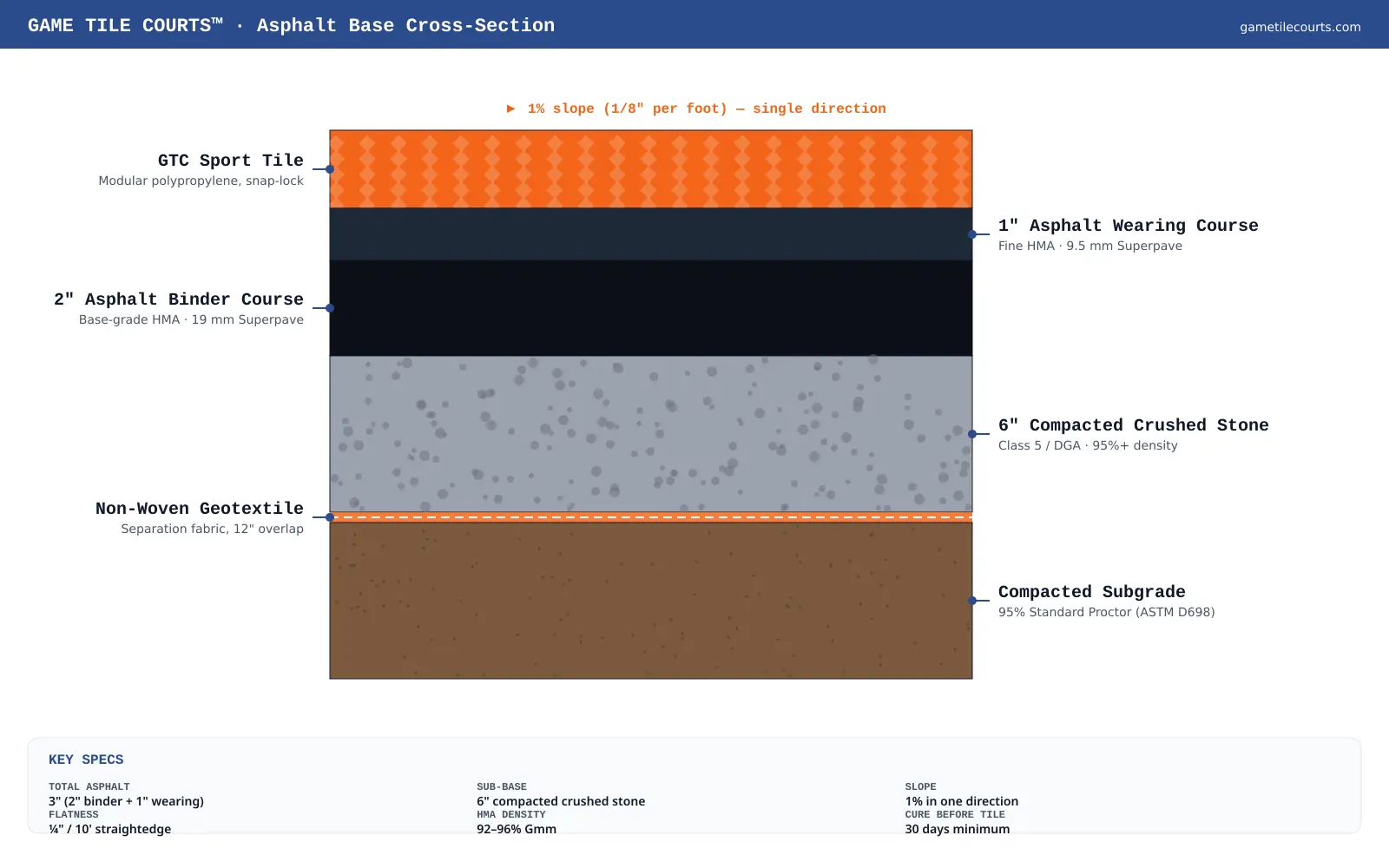
- Wearing (surface) course: 1" of fine-graded HMA - typical 9.5 mm Superpave or state DOT equivalent
- Binder course: 2" of base-grade HMA - typical 19 mm Superpave
- Tack coat: CRS-1 or SS-1h emulsion between binder and wearing course (per ASTM D977)
- Aggregate sub-base: 6" of compacted crushed stone (Class 5 / DGA / #57 + #21A blend)
- Geotextile fabric: Non-woven separation fabric between subgrade and aggregate
- Subgrade compaction: 95% Standard Proctor density (ASTM D698)
- Aggregate compaction: 95%+ relative compaction, placed in 3" max lifts
- HMA compaction: 92-96% of theoretical maximum density (Gmm)
- Slope: 1% (1/8" per foot) in one direction - never crowned
- Flatness tolerance: 1/4" deviation over 10' straightedge
- Cure time before tile install: 30 days minimum (45+ in cool climates)
GTC's spec exceeds the typical "2" binder + 1/2" wearing" residential standard by adding a full 1" wearing course for better long-term wear resistance and a 6" compacted stone sub-base for superior load distribution.
Step-by-Step Build
- Excavate 9-10" below finished grade and proof-roll the subgrade.
- Compact subgrade to 95% Standard Proctor; correct any soft spots.
- Lay non-woven geotextile fabric over the compacted subgrade with 12" overlapped seams.
- Place crushed stone in 3" max lifts, compacting each lift to 95%+ relative density. Total 6".
- Pave the binder course (2" base-grade HMA) at 275-325°F mat temperature; roll while hot to 92-96% density.
- Apply tack coat (CRS-1 or SS-1h emulsion) at 0.05-0.10 gal/yd²; allow to break.
- Pave the wearing course (1" fine HMA) at the design slope; finish-roll smooth.
- Cure 30 days minimum before tile install (45+ days in cool climates).
- Pressure wash the cured surface to remove residual oils and dust.
- Verify flatness with a 10' straightedge before tile install - repair any >1/4" deviations.
Existing Asphalt Court? Suitability Checklist
Already have an asphalt driveway or an old asphalt basketball court? It can often take tiles as it is. Check it against this list first:
- No cracks wider than 1/4" or longer than 3' (patch and seal first).
- No depressions that hold standing water after rain.
- Slope present in one direction (1% minimum).
- Edges firm - no crumbling or alligator cracking.
- Surface clean of oil, moss, or loose aggregate.
- At least 30 days cured since last paving or seal coat.
Common Mistakes to Avoid
- Installing tiles on fresh asphalt - oils will bleed and stain the tile underside.
- Skipping the binder course - single-lift paving deforms under point loads (hoop posts, net posts).
- Inadequate sub-base compaction - causes settlement, birdbaths, and frost heave.
- Crowning the surface - modular tile expects a single-direction slope.
- No tack coat between lifts - leads to delamination of the wearing course.
Cost note: Asphalt pricing varies with site prep, accessibility, mix design, and regional labor rates. Request quotes from local licensed paving contractors for an accurate estimate.
Engineering disclaimer: Mix designs, lift thicknesses, and compaction targets should be confirmed with a local Professional Engineer or licensed paving contractor based on regional climate, soil conditions, and DOT specifications.
Frequently Asked Questions
Can you put court tiles on an existing asphalt basketball court?
Yes. Modular Game Tile Courts™ tiles are designed to install over a properly compacted, court-grade asphalt surface. The asphalt should be sound, free of major cracks or potholes, sloped for drainage, and fully cured before tile install. Run the existing asphalt through the suitability checklist on this page first, and patch and seal any cracks before the tiles go down.
How thick should the asphalt be for a sport court?
GTC recommends 3" of total compacted asphalt - a 2" binder course plus a 1" wearing course - over a 6" compacted crushed stone sub-base. This exceeds typical residential specs and adds long-term durability under modular tile.
How long does asphalt need to cure before installing tiles?
Allow at least 30 days of cure time, longer in cool weather. Fresh asphalt continues to off-gas oils that can stain tiles if installed too early. Pressure wash before tile install.
What's the lifespan of an asphalt court base?
A well-built asphalt base lasts 15-25 years before needing seal-coat or resurfacing. Tiles can be lifted and reinstalled when the asphalt is refreshed.
Is asphalt cheaper than concrete?
Asphalt is typically 15-30% less expensive up front than concrete, but it has a shorter lifespan and requires periodic seal-coating. Concrete usually wins on lifetime cost; asphalt wins on initial budget and install speed.