The sport court base under your tiles is the single most important decision in any court build. Compare concrete, asphalt, and permeable gravel, and choose the right foundation for your climate, budget, and use case.
Why the Base Matters
Modular Game Tile Courts™ tiles are engineered to perform on top of a properly prepared sub-base. The base controls drainage, flatness, ball bounce, longevity, and warranty eligibility. A great tile cannot compensate for a poor base - but a great base will make every tile feel professional for decades.
Whether you call it a slab, a basketball court pad or a basketball pad for backyard games, the job is the same: give the tiles a flat, stable, well-drained surface to float on. Game Tile Courts supplies the tile surface, court kits and accessories. We do not pour concrete or pave asphalt; your base is built by a licensed local contractor to the specs in the guides below.
Quick Comparison: Concrete vs Asphalt vs Gravel
Base Type
Relative Cost
Drainage
Best For
Concrete
$$$
≈1% slope
Any sport or court type
Asphalt
$$
≈1% slope
Any sport or court type
Permeable Gravel
$$
Fully permeable
Any sport or court type
The Three Base Options - In Detail
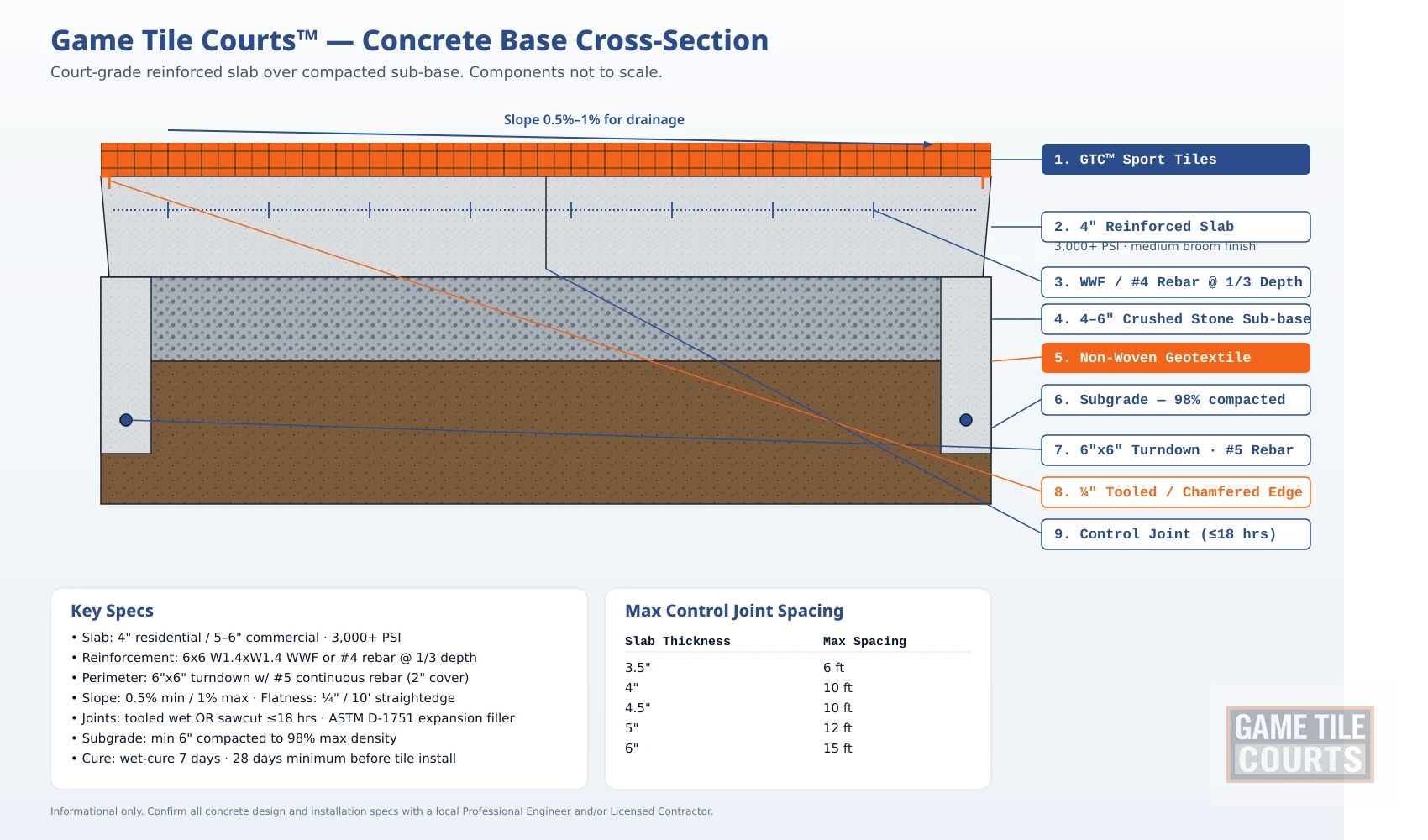
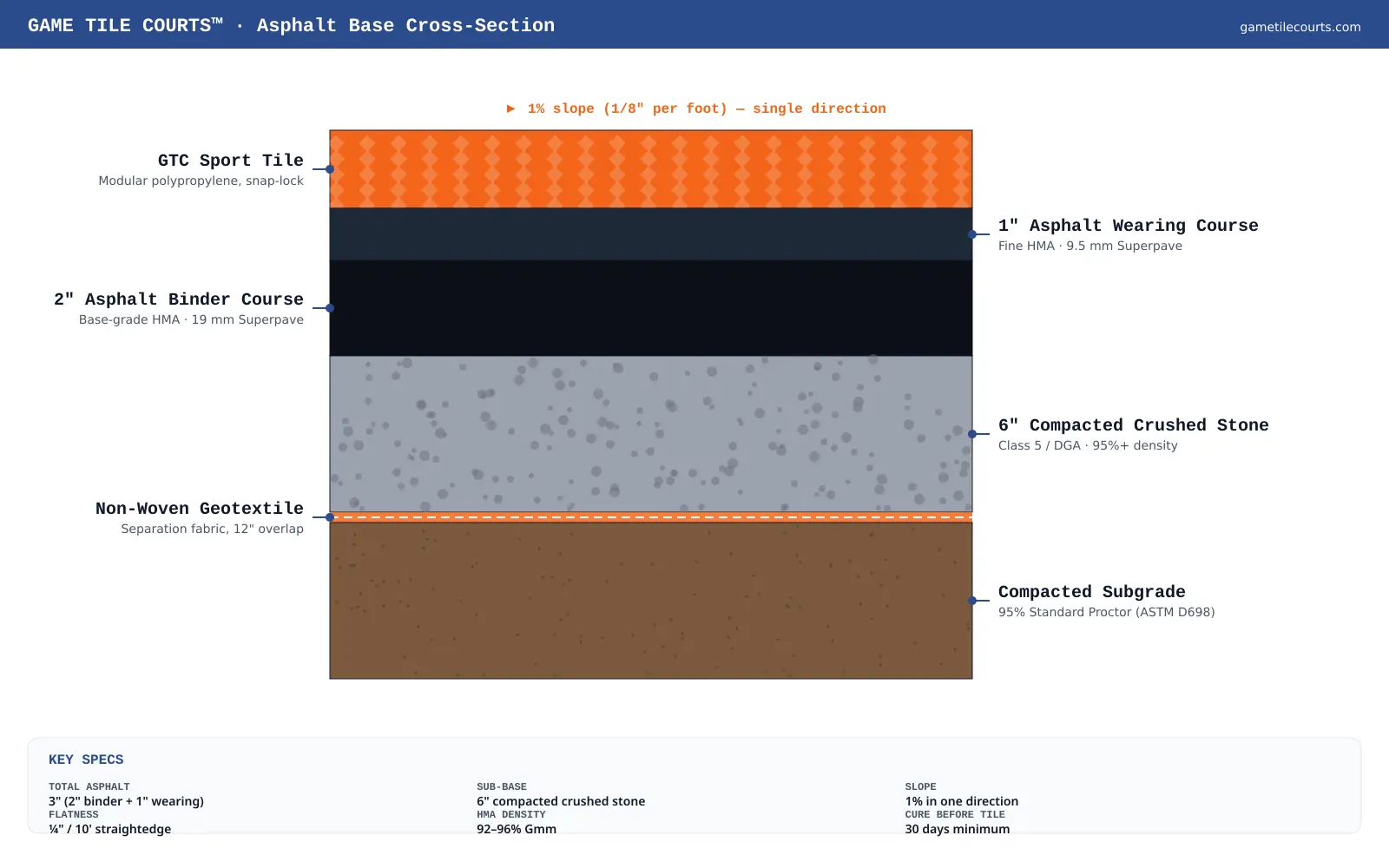
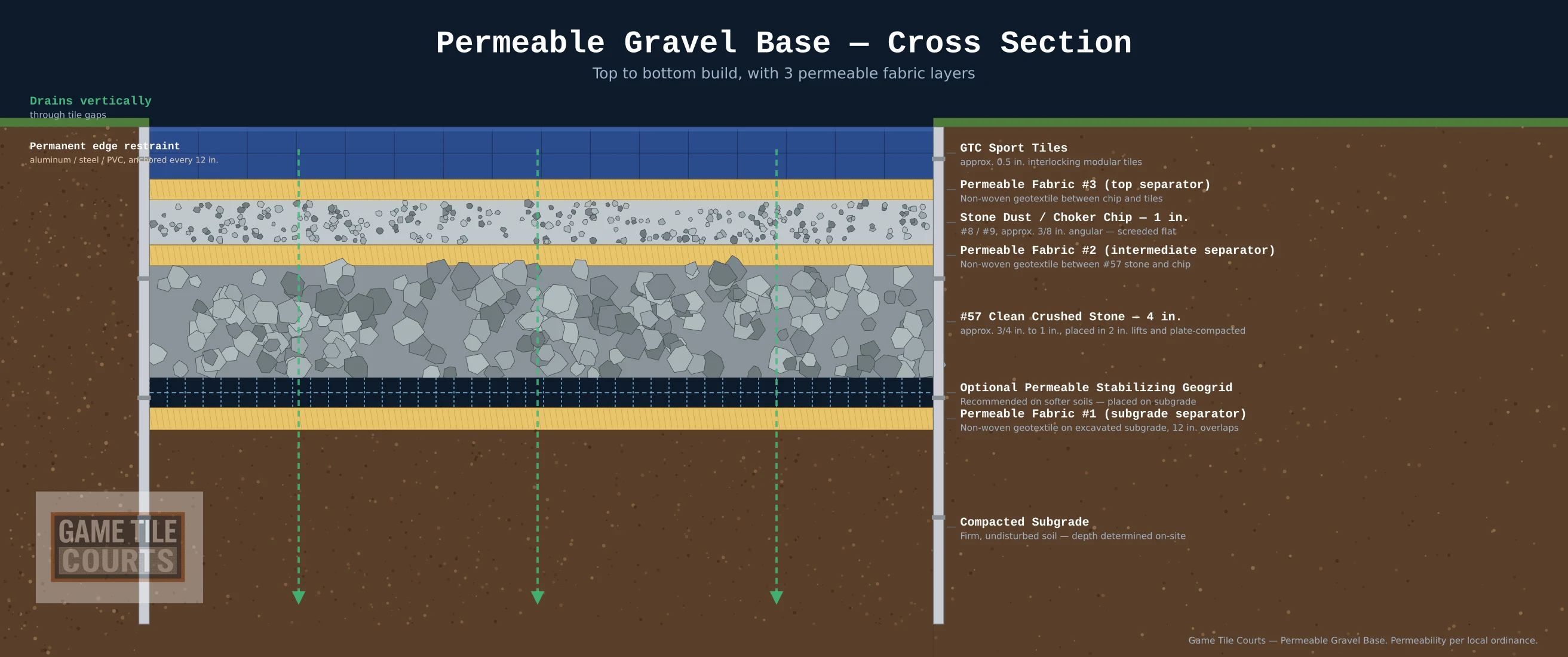
Each option below includes a full cross-section diagram, spec sheet, and step-by-step build guide. Click through for the complete contractor-grade documentation, or download the printable PDF.
Lowest Lifetime Cost
Concrete Base
Higher upfront capital expense, but the lowest cost of ownership going forward. The flattest, longest-lasting, and most consistent base - works for any sport or court type.
Relative Cost
$$$
Drainage
≈1% slope
Best For
Any sport or court typeLowest lifetime cost of ownershipMaximum longevity & flatness
A lower-cost entry point for a strong, impervious base. Installs faster than concrete and supports any sport or court type when built to court-grade specs.
Relative Cost
$$
Drainage
≈1% slope
Best For
Any sport or court typeLower upfront entry costStrong impervious base
The easiest base on the body - knees and joints - and meets requirements for permeable builds and stormwater drainage. Works for any sport or court type when paired with geotextile fabric and edge restraint.
Relative Cost
$$
Drainage
Fully permeable
Best For
Any sport or court typeEasier on knees & jointsPermeable & stormwater compliant
Every option below works for any sport or court type. The right sport court base material comes down to your budget horizon, your drainage rules and how permanent you want the court to be.
Concrete - Higher upfront capital expense, but the lowest cost of ownership going forward. Works for any sport or court type. Build a new concrete basketball court base to our slab specs.
Asphalt - Lower entry cost for a strong, impervious base. Works for any sport or court type. See the asphalt basketball court guide for lift thickness and cure time.
Permeable Gravel - Easiest on the body, knees, and joints. Meets requirements for permeable builds and stormwater drainage. Works for any sport or court type. Our permeable basketball court guide covers every layer.
Pavers - Possible in select cases. See our FAQ on tiles over pavers for the constraints.
Alternatives to Concrete for an Outdoor Basketball Court
Homeowners looking for alternatives to concrete for outdoor basketball court builds usually have one of three reasons: a lower upfront budget, an HOA or town rule against impervious surfaces, or a wish to keep the court removable. Asphalt answers the first. A permeable gravel base answers the second and third, because water drains straight through the tile gaps and the stone, and the tiles can be lifted later.
Either one makes a solid outdoor basketball pad when it is built to court-grade specs with a rigid edge for the tile perimeter to lock against. What does not work is laying tiles straight onto grass, dirt or mulch.
Sizing the Backyard Basketball Pad
Size the backyard basketball pad to the court, not the other way around. Start by measuring the usable footprint of your yard and sending it with a few photos when you request a free Court CAD Layout. Our team returns a to-scale drawing of the largest court that fits, with hoop placement, backboard overhang and the perimeter edges and ramps already dimensioned, so your contractor can form the pad to match. For standard court sizes, see our guide to basketball court dimensions, and if space is tight, compare half court basketball court layouts.
In-ground hoop poles, sleeved net posts and light poles are set during base work, so decide on them before the pad is poured or paved. Request your free Court CAD Layout before you book the base.
Print-Ready Spec Sheets
Branded PDF guides for your contractor or design team - one per base type.
If you already have a concrete pad, asphalt driveway, or paver patio, our team can evaluate whether it's tile-ready. Send dimensions and a few photos to play@gametilecourts.com or call 866-GAME-TILE for a free assessment.
Pro tip: No matter which base you choose, plan for a 1% slope in one direction and finish the perimeter with a clean edge for the tile transition system to lock against.
Avoid: Bare dirt, mulch, grass, or unprepared subsoil - none of these will support a tile court.
Frequently Asked Questions
What is the best base for a sport court?
Concrete is the gold standard for a backyard sport court because it provides the flattest, longest-lasting, and most level surface for modular tiles. Asphalt is a strong second choice when poured to court-grade specs, and a permeable gravel base can work for budget-conscious or seasonal builds when paired with the proper geotextile fabric and edge restraint.
What can I use instead of concrete for an outdoor basketball court?
Court-grade asphalt and a permeable gravel base are the two proven alternatives. Asphalt gives you a strong, impervious base at a lower entry point than concrete. Permeable gravel is the easiest base on knees and joints, drains straight through, and meets requirements for permeable builds and stormwater drainage when it is built with geotextile fabric and a rigid edge restraint. Pavers are possible in select cases. Bare dirt, grass, mulch or unprepared subsoil will not support a tile court.
Can Game Tile Courts™ tiles be installed over an existing driveway or patio?
Yes. Modular Game Tile Courts™ tiles can be installed over an existing concrete or asphalt slab as long as the surface is structurally sound, drains properly, and is within acceptable flatness tolerances (typically 1/4" deviation over 10 feet). Cracked, heaving, or sloped slabs may require leveling or repair before tile installation.
How thick does a concrete base need to be for a basketball court?
We recommend a minimum 4-inch thick reinforced concrete slab for residential basketball, pickleball, and multi-sport courts. Thicker pours (5-6 inches) are recommended in freeze-thaw climates or where heavy commercial traffic is expected.
What slope is required for outdoor court drainage?
Plan for a 1% slope (about 1/8" per foot) in a single direction across the playing surface. This is enough to shed rainwater off the tiles without affecting ball bounce or player footing.
How do Game Tile Courts™ tiles interact with concrete expansion joints?
Modular tiles float on top of the slab and follow the overall planarity of the court, so expansion joints generally do not affect performance across the playing surface. However, where a tile's underside legs land directly over an expansion joint, the legs can drop slightly into the joint cavity. This can create a localized soft spot that may subtly affect ball bounce or feel on that specific tile.
Ready to plan your court?
Talk to a Game Tile Courts™ specialist for a free Court CAD Layout, base recommendations, and a same-day quote.