
Base Guide
Permeable Basketball Court: Gravel Base Guide
Permit-friendly, stormwater-compliant, and removable. A compacted gravel base is the ideal foundation for a permeable basketball court when you can't pour concrete or asphalt.
Why Choose a Permeable Gravel Base
A permeable basketball court lets rain drain straight down through the tile gaps and the stone base instead of running off a slab. Permeable gravel bases solve the problems concrete and asphalt can't:
- HOA-friendly - No "impervious surface" violations.
- Permit-friendly - Often classified as a removable improvement.
- Stormwater-compliant - Water drains straight through.
- Removable - Lift the tiles and the gravel can stay or be repurposed.
- Lower upfront cost - Typically the least expensive court base.
Permit rules still vary by town, so confirm yours before you dig. Our guide to backyard court permits covers what to ask. To compare gravel with concrete and asphalt, see every sport court base option side by side.
Recommended Specifications
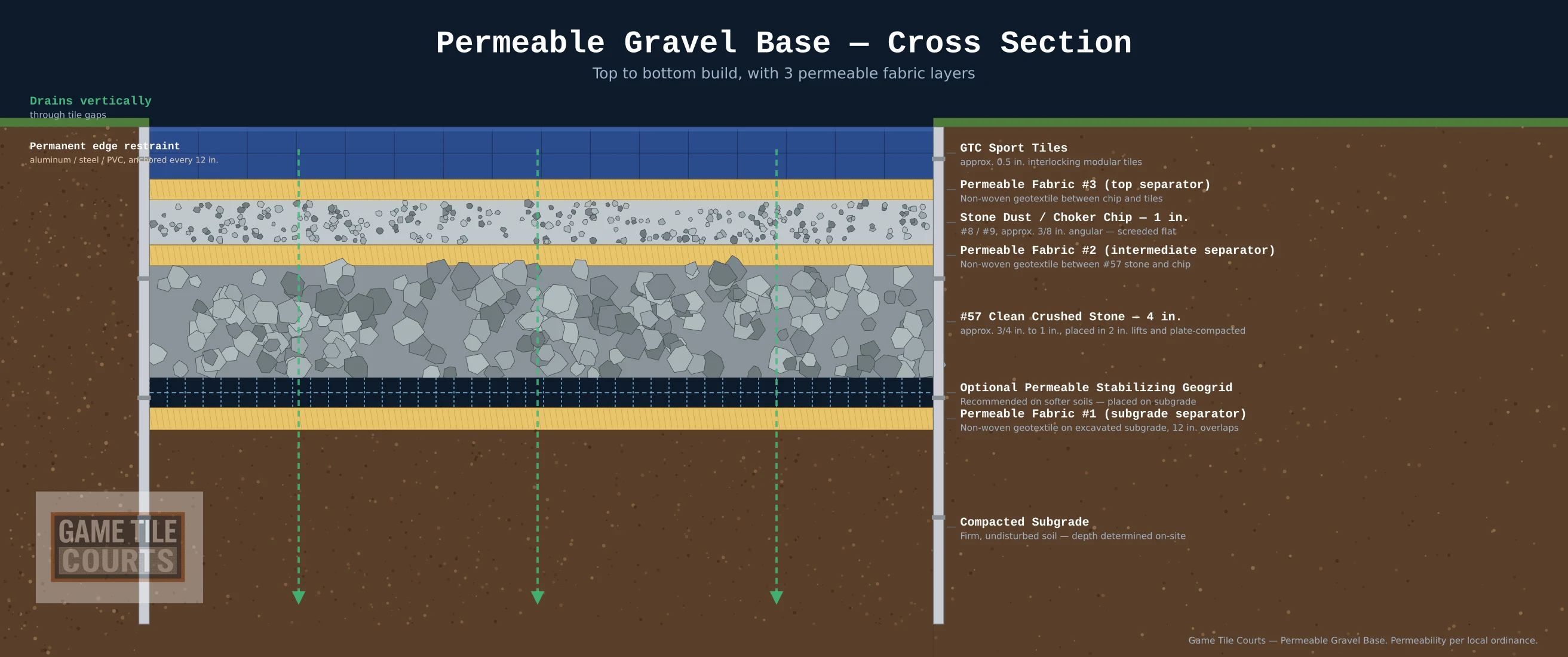
The system uses three permeable fabric layers for separation, filtration, and protection:
- Fabric Layer #1 - Subgrade separator (mandatory): Non-woven permeable geotextile placed on the excavated subgrade, with 12" overlaps at seams. Keeps subsoil from migrating up into the stone base.
- Optional stabilizing fabric: Permeable woven geogrid or paver-grid placed on top of Fabric #1 - recommended for extra court stability on softer soils.
- Bottom layer (aggregate base): 4" of compacted #57 / Class 5 crushed stone (about ¾" - 1" clean, angular crushed stone - ask your stone yard for "#57") placed in 2" lifts.
- Fabric Layer #2 - Intermediate separator (mandatory): Non-woven permeable geotextile between the #57 stone and the choker chip. Prevents the fine chip from migrating down into the larger stone voids.
- Choker / leveling layer: 1" of clean #8 or #9 angular stone (≈⅜" angular "chip", also called "choker stone"), screeded flat.
- Fabric Layer #3 - Top separator (mandatory): Non-woven permeable geotextile between the choker chip and the GTC tiles. Protects the underside of the tiles and keeps the chip in place.
- Edge restraint: Aluminum, steel, or PVC paver edging anchored every 12".
- Compaction: Plate compactor on each lift, finishing with the leveling chip.
- Slope: 1% (1/8" per foot) in one direction (optional - surface drains vertically).
- Flatness tolerance: 3/8" deviation over 10' straightedge.
*Permeability is officially confirmed by what your local town ordinances accept as permeable. The system described above is generally considered permeable. All fabrics specified must be permeable.
Step-by-Step Build
- Excavate to firm, undisturbed subgrade (depth determined on-site by your contractor based on soil conditions and finished tile elevation).
- Lay Permeable Fabric #1 - non-woven geotextile across the full footprint, lapped 12" at seams.
- Optional - install a permeable stabilizing geogrid / paver-grid on top of Fabric #1 for extra court stability before any stone is placed.
- Install perimeter edge restraint set to finished grade.
- Place 4" of #57 crushed stone (¾" - 1" clean angular stone) as the bottom layer, in 2" lifts, plate-compacting each lift.
- Lay Permeable Fabric #2 - non-woven geotextile across the compacted #57 stone, lapped 12" at seams.
- Spread the leveling chip on top of Fabric #2 - #8 / #9 stone (≈⅜" angular chip) 1" deep, screeded flat to the design slope.
- Roll or plate-compact lightly until the surface is firm under foot.
- Lay Permeable Fabric #3 - non-woven geotextile across the screeded chip, lapped 12" at seams.
- Install GTC tiles directly on top of Fabric #3 - no cure time required, no rubber mat required.
Your contractor builds the base to these specs; Game Tile Courts supplies the basketball court tiles, edges and accessories that go on top.
Common Mistakes to Avoid
- Skipping the geotextile fabric - soil migrates up and the base settles.
- Using rounded "pea gravel" - it doesn't lock and shifts under load.
- Skipping edge restraint - the perimeter spreads and the surface collapses inward.
- Compacting in one big lift - leaves voids and causes long-term settling.
- No stabilizing grid - surface is more prone to ruts and depressions.
Cost note: Base pricing varies widely by region, site prep, accessibility, and contractor. Request quotes from local licensed contractors for an accurate estimate.
Frequently Asked Questions
Can sport tiles be installed on gravel?
Yes. Modular Game Tile Courts™ tiles can be installed on a properly engineered permeable gravel base. The system uses a compacted crushed-stone base with stabilizing grids and a clean leveling layer to provide a firm, free-draining foundation.
Can a basketball court be built without concrete?
Yes. A permeable basketball court on a compacted gravel base needs no concrete or asphalt. Modular tiles go directly on the finished base, with no cure time and no rubber mat required. Court-grade asphalt is the other alternative if you want an impervious base.
When should I choose a gravel base?
Choose a permeable gravel base when you can't pour concrete or asphalt due to permits, HOA rules, stormwater requirements, or budget. It's also ideal for seasonal courts and properties where you want the option to relocate or remove the court.
How long does a gravel court base last?
A properly built gravel base lasts 10-15 years with light maintenance. Periodic top-off of the leveling layer and re-leveling of any settled areas keeps it performing well.
Will the surface stay flat over time?
When built with a stabilizing grid and properly compacted in lifts, settlement is minimal. Annual inspection and minor top-dressing are typical maintenance.
Does a permeable gravel court drain better than concrete?
Yes - water passes directly through the tile gaps and gravel base back into the soil, which is ideal for stormwater compliance and HOAs that restrict impervious surfaces.