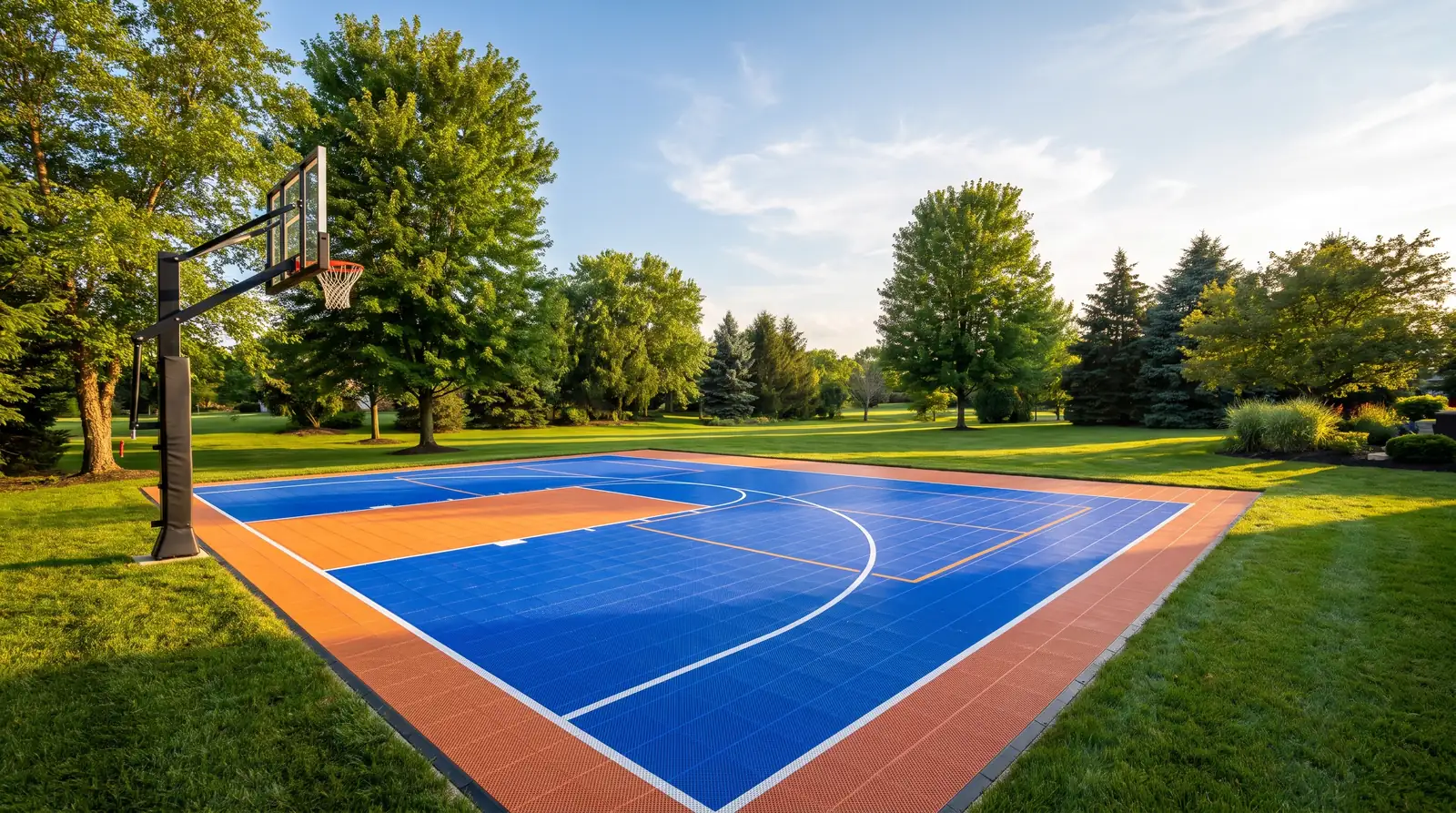
What Is the Best Outdoor Basketball Court Surface?
The right outdoor basketball court surface makes a backyard court feel like a real gym. The wrong one feels like a parking lot. Here's what separates premium sport tile from asphalt and bare concrete, and how to pick the best material for your backyard basketball court.
What to Look for in an Outdoor Basketball Court Surface
The best outdoor basketball court surface needs four things: consistent ball bounce, UV resistance so colors don't fade, drainage channels so the surface dries fast, and enough cushion to protect joints during lateral cuts and jumps.
Every basketball court surface outside lives through sun, rain and freezing nights, so judge a backyard basketball court surface on how it plays in year ten, not just on day one. A good outdoor basketball surface keeps the same bounce from the free throw line to the corner, dries quickly after a storm and gives a little underfoot. When you compare an outdoor basketball court surface material, ask the seller how it handles each of those four tests.
Why Modular Polypropylene Tile Wins
Game Tile Courts™ modular sport tiles are made from high-density polypropylene with a ribbed underside that provides airflow, drainage, and shock absorption that flat concrete can't match. The interlocking GTC FIT™ system creates a surface that performs like a hardwood gym floor - outdoors.
The best outdoor basketball court tiles share that construction: a vented, ribbed underside, a textured top and a locking system that holds seams flush. A polypropylene basketball court also snaps together without adhesive, so the tiles sit on your existing pad rather than bonding to it. That is why modular tile is the backyard basketball surface under every backyard basketball court we design.
Tile vs. Asphalt vs. Concrete
Most outdoor basketball court surface options come down to three: bare asphalt, bare concrete, or modular tile laid on top of either one. Asphalt and concrete are cheaper upfront but require sealing, line repainting every 3-5 years, and have zero cushion. Tile installs over any flat surface, never needs sealing, and the game lines are molded into the tile - they don't peel or fade. See our full basketball court painting vs tiles comparison.
Tile does not replace the pad underneath, it sits on it. So when you compare outdoor basketball surface options, you are really choosing what the ball and your knees touch: painted slab or cushioned tile. Our guide to choosing a sport court surface walks through the trade-offs in more depth.
Best Material for a Backyard Basketball Court
For most families, the best material for backyard basketball court builds is modular polypropylene tile over a flat concrete or asphalt pad. It is the best outdoor basketball court material we know of for a home court because it combines the grip, drainage and UV resistance above with a surface you can lift, extend or rearrange later.
Within tile, the basketball court material you pick comes down to how much cushion you want. All-Court Classic is our best-value line for families, schools and community courts. If joints are the priority, Cushioned Flex Pro builds a soft basketball court with a dual-layer cushion system, a temperature range of -20°F to 150°F and a 12-year warranty. Both are genuine outdoor basketball court material with published ratings well below freezing (All-Court Classic runs from -30°F to 160°F), not indoor floors moved outside.
Whichever line you choose, every kit of basketball court tiles is counted from your approved CAD layout, including edges, ramps and corners.
Why Hardwood Does Not Belong Outdoors
An outdoor hardwood basketball court sounds like the dream, but real hardwood is made for climate-controlled gyms, not for rain, direct sun and freezing nights. Our own hardwood-look line, Indoor Flex Hardwood, is rated Indoor Only, with a temperature range of 40°F to 100°F. Indoor tiles are not waterproof at the seams and carry no UV rating, so no indoor floor makes a good backyard basketball floor.
If you want the feel of a gym floor outside, pick an indoor-and-outdoor polypropylene line. You get a consistent basketball playing surface with the drainage and weather ratings that outdoor play demands.
Tile Color and Game Line Options
Our sport tiles come in 15 colors with pre-cut game line options for basketball, pickleball, tennis, and multi-sport configurations. Most popular combo: navy + orange tiles with white basketball lines. Custom Pantone color matching is available.
Frequently Asked Questions
Q: What is the best surface for an outdoor basketball court?
A: Modular polypropylene sport tile over a flat concrete or asphalt pad. It is the best outdoor basketball surface for a home court because it gives consistent bounce, resists UV fading, drains through the surface and adds cushion that bare slab cannot. Choosing a surface for outdoor basketball court use comes down to those four tests.
Q: What material is best for a backyard basketball court?
A: Polypropylene tile is the best material for outdoor basketball court use at home. Compared with any other backyard basketball court material, it installs over an existing pad, needs no sealing and keeps its lines. Pick a basketball court material outdoor weather cannot break down, which rules out indoor floors and real wood.
Q: Can you put a hardwood basketball court outside?
A: Not real hardwood, and not an indoor hardwood-look tile either. Our Indoor Flex Hardwood line is rated Indoor Only, 40°F to 100°F. For outdoor basketball court options with a gym-floor feel, choose an indoor-and-outdoor polypropylene tile line.
Q: What is the best basketball surface for backyard courts in cold climates?
A: Choose a tile line that publishes a temperature range below freezing. Cushioned Flex Pro, for example, is rated from -20°F to 150°F. Tile is the best surface for backyard basketball court builds in freeze and thaw regions because the field floats and can expand and contract with the seasons.
Q: Do sport tiles get slippery when wet?
A: No. The perforated surface channels water away, and the ribbed texture maintains traction even after rain.
Q: What size basketball court fits in a typical backyard?
A: A 30×50 ft space fits a solid half-court. 40×60 ft fits a full recreational court. Use our Court Builder to size your space.
Q: How long does sport tile last?
A: Game Tile Courts™ tile is backed by up to a 15-year limited warranty and typically lasts 20+ years with minimal maintenance.