
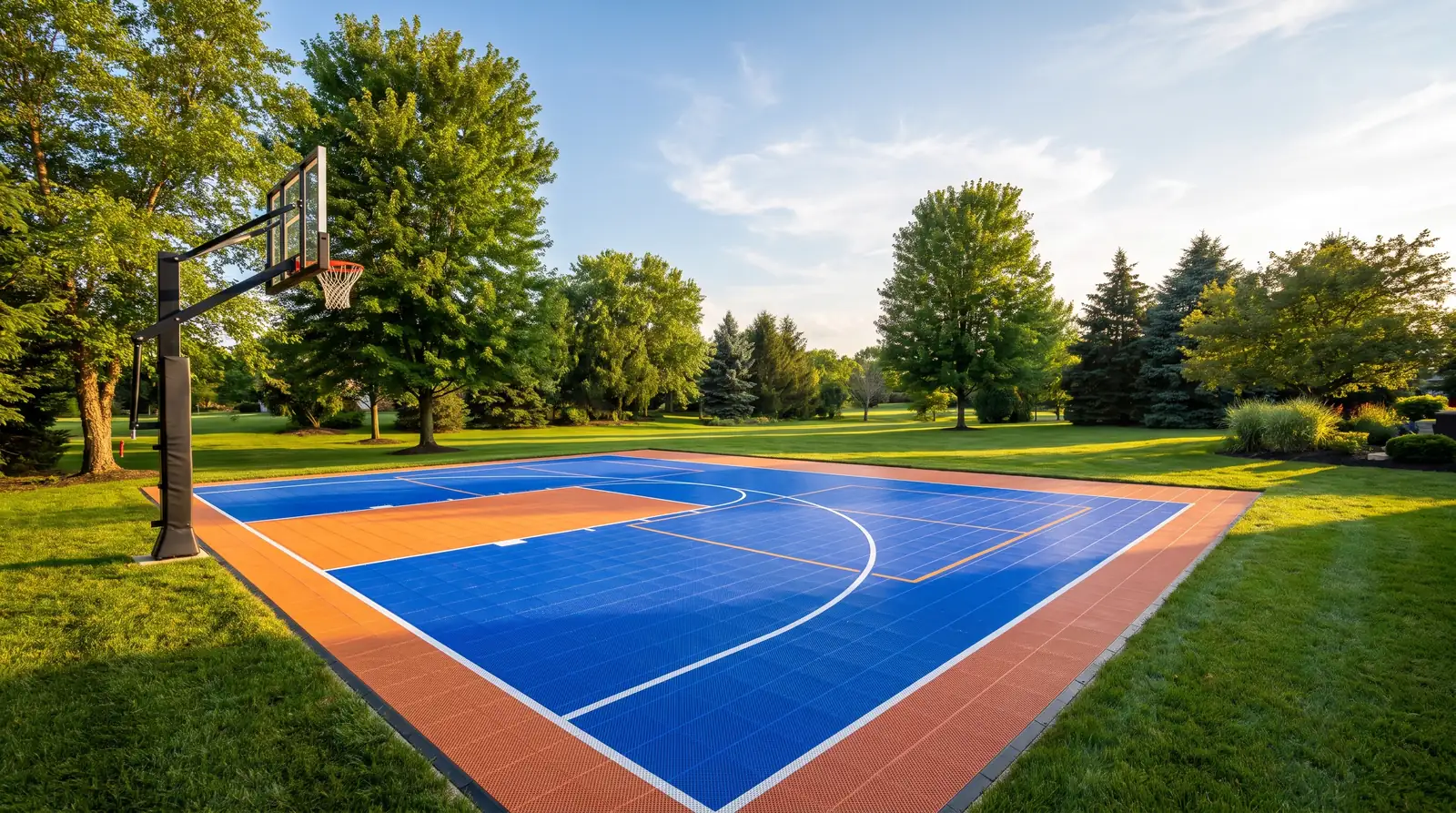
Half Court Basketball Courts for Backyards
Half court basketball needs one hoop, one key and one three-point arc, with room for everything from free throws to 3-on-3. Each court is made of modular sport tiles laid over a flat concrete or asphalt pad, with game lines, a hoop plan and a free CAD layout. Snap it together yourself from a kit, or work with a certified installer.
Half Court Sizes at a Glance
There is no single backyard half court size. Most families planning a half court basketball backyard project choose between four common backyard sizes. None of them is a regulation court, and that is fine: a basketball half court for backyard play is sized to the yard, not to a rulebook.
20 x 25 ft: Shooting area
A 20x25 basketball court covers free throws, shooting drills and one-on-one.
25 x 30 ft: 3-on-3
Room to run a 3-on-3 game with a single hoop.
28 x 50 ft: Narrow half court
A slightly narrower version of the standard backyard half court.
30 x 50 ft: Standard backyard half court
The compact driveway or small-backyard preset in our Court Builder.
Below 25 by 42 ft our Court Builder stops offering regulation basketball geometry, which is why the two smaller sizes are described as a shooting area and a 3-on-3 setup rather than a half court. For comparison, a regulation high school half court measures 50 by 42 ft, half of the 50 by 84 ft full court. The builder default of 40 by 60 ft holds a recreational half court alongside a full pickleball court with generous runoff.
For every line and measurement, see our guide to half court basketball dimensions.
Pre-boxed half court kits, GTC 7 to GTC 10
If you would rather start from a fixed layout than draw one from scratch, our half court kits come in four play areas on 12 by 12 inch tiles. Every kit includes a CAD/Submittal package and step-by-step tile installation instructions tailored to the court design.
GTC 7
Half Court, Standard
Play area 44 ft 3 in by 28 ft 2 in
GTC 8
Half Court, Plus
Play area 45 ft 11 in by 29 ft 11 in
GTC 9
Half Court, Wide
Play area 49 ft 4 in by 30 ft 9 in
GTC 10
Half Court, Regulation Width
Play area 59 ft 5 in by 30 ft 9 in
What a Half Court Includes: Key, Three-Point Arc and Hoop Placement
A half court is one end of a full court. It has a single hoop, a key (the lane) in front of it, a free throw line and a three-point arc. When you enter a pad under 70 ft long, the Court Builder draws exactly that: one key and one arc, with the hoop at one end of the pad and a dashed line at the far end. At 70 ft and longer it switches to a full court with two keys.
- Key: 12 ft wide at high school and college level, 16 ft wide at NBA level, with the free throw line 19 ft from the baseline.
- Hoop: the center of the basket sits 5.25 ft (5 ft 3 in) in from the baseline.
- Three-point arc: 19 ft 9 in for high school, 22 ft 1.75 in for NCAA and 23 ft 9 in for NBA, measured from the center of the basket.
- Hoop mount: half courts use a single hoop, in-ground or surface-mount, and the hoop location and backboard overhang are dimensioned on your CAD layout and confirmed before installation.
On a residential half court basketball layout, the three-point geometry is laid out from the pad width, so the arc has to fit the pad you have. Every position, from the hoop to the arc, is dimensioned on your CAD drawing.
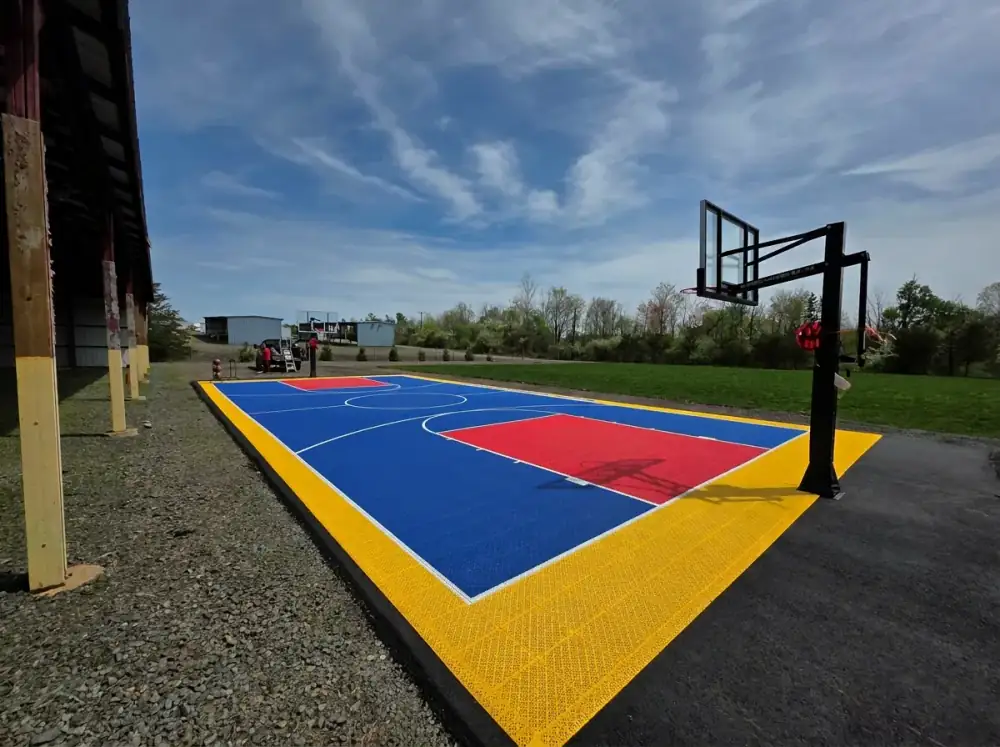
Half Court Basketball Tiles for Outdoor Play
Outdoor half court basketball needs a surface that drains, holds its color and gives a true bounce. Our basketball half court tiles are molded with color through the whole tile and UV stabilizers in the pigment, so they resist the fading and chalking paint shows within a season or two.
On a sport court half court, the lines are tiles too. Line tiles are factory-painted in your kit colors and dropped in per the CAD: key, free throw line and three-point arc. Nothing is painted onto the slab in the field, and we do not paint courts. Browse our basketball court tiles in pre-boxed kits, or pick a tile line below.
GTC Cushioned Flex Pro
More impact reduction and a softer feel underfoot, made for basketball, volleyball, training and family play.
View DetailsGTC Dink Pro
Our flagship all-around tile with precision ball response, confident grip and fast drainage.
View DetailsGTC All-Court Classic
The best-value all-around multi-sport tile for families, schools, churches, camps and HOAs.
View DetailsWarranty terms vary by tile line, up to a 15-year limited warranty across our range. Each product page lists its own warranty and temperature rating.
Building a Half Court: Base, Tiles, Lines, Hoop
Building a half court basketball court happens in a fixed order, and the base comes first. Whether you are adding a half court outdoor basketball court to a new yard or resurfacing an old driveway pad, these are the four stages of every half basketball court backyard project.
1. The base
Tile does not replace a base, it sits on one. A structurally sound concrete or asphalt pad that drains and holds within about a quarter inch under a 10-foot straightedge is ready for tile. Bare dirt, grass, mulch and unprepared subsoil will not support a court, and pavers are not recommended for new builds. If you are pouring a new slab for a concrete basketball court, the guide calls for at least 4 inches of reinforced concrete for residential courts and a 28-day cure before tile goes down. We do not pour concrete or asphalt. Base work is quoted separately by a licensed local contractor. Certified installers handle tile, lines, hoop and net placement.
2. The tiles
Tiles snap together without adhesive and the field floats on the base. Only the perimeter edge tiles are anchored, with screws into concrete or asphalt, so the surface can expand and contract with the weather. Our anchoring guide shows how.
3. The lines
Line tiles drop in where the CAD layout places them. A custom half court basketball court can carry your own line colors and a logo; custom color-matched and logo tiles need design approval before production and cannot be returned, so settle them at CAD stage.
4. The hoop and accessories
Decide on the hoop, containment netting and court lighting early. Structural steel poles for lights or netting need to be engineered and sleeved into the sub-base before the surface goes down. Decided after the tile is laid, they become base work.
What drives the cost. Five things move the number: the tile line, the court size, the condition of your base, DIY or professional installation, and accessories like the hoop, fencing and lighting. Every GTC quote is all-in for the court package, with tiles, ramps, corners, game lines, freight and a free CAD layout in one number. Our guide to half court basketball court cost walks through each driver, or request a firm quote for your yard.
When building outdoor basketball half court projects, the yard itself matters as much as the court: slope, truck access for base work, and drainage all show up in the base contractor's bid.
Half Court Installation: DIY Kit or Professional Install
Basketball half court installation is the easy part of the project once the base is ready. Homeowners who set out to build a half basketball court in the backyard can do the tile work themselves or hand it to a certified installer. Either way, half court basketball installation follows the same CAD layout.
DIY court kit
- Pre-boxed kits include tiles, court lines and installation guides.
- Most residential courts, from 20x25 to 30x50, can be installed in one day over concrete or asphalt.
- Laying the tile yourself does not void the tile warranty.
Professional install
- Certified installers follow your approved CAD layout. Find one on our certified installer directory.
- A pro crew books one to two days for a 40 by 60 ft court, time that also covers game line marking and a post-install inspection and walkthrough.
- Financing is available for qualified buyers, subject to approval.
A home half court basketball setup is also an easy way to build half court basketball into a yard you already have: if the driveway pad is sound, the tile days are close to the whole schedule.
Adding Pickleball Lines to a Half Court
A half court sport court with a second set of lines gets used by more of the family. Basketball and pickleball is the pairing most families build, and a regulation pickleball court is 20 by 44 ft. For the pair we recommend a 30 by 60 ft pad: a recreational half court with a full pickleball court laid over it in contrasting line colors.
On a 30 by 50 ft pad the pickleball court is centered and the half court hoop sits 5.25 ft from the end of the pad, so the hoop lands inside the pickleball court. Hoop placement and overhang are locked on the CAD layout for that reason, so flag it in your quote request. Tennis, pickleball and badminton all run on the same Multi-Sport Net System with adjustable height.
Because every sport shares the same ground, line color is what keeps a pickleball basketball court readable. Read how the overlay works in our guide to pickleball basketball court line markings, try a sport court design in the Court Builder, or see our multi-sport courts for bigger layouts. Even with pickleball lines added, a half sport court keeps its one hoop and one key; you simply get more games from the same tiles.
Half Court Installation by State
Game Tile Courts ships court kits nationwide and works with certified installers. For state-specific permit notes and questions about a backyard half basketball court where you live, start with your state page.
Half Court Questions
Straight answers for anyone planning to play half court basketball outdoors at home.
- What size is a backyard half court basketball court?
- Common backyard sizes are 20 x 25 ft for a shooting area, 25 x 30 ft for 3-on-3, 28 x 50 ft, and 30 x 50 ft, which is the standard backyard half court. None of these is a regulation court: a regulation high school half court is 50 by 42 ft, half of the 50 by 84 ft full court. Measure the flat usable area, plan a 3-foot safety buffer around the tile perimeter, and we will size your court on a free CAD layout. Read the basketball court dimensions guide
- Can I build a half court basketball court myself?
- Yes. The tile layer is DIY friendly: tiles snap together without adhesive, the field floats on the base, and only the perimeter edge tiles are anchored with screws into concrete or asphalt. Pre-boxed court kits include the tiles, court lines and installation guides, and laying the tile yourself does not void the tile warranty. The base is the part to hire out if you do not already have a sound, flat pad. See the anchoring guide
- Can a half court also have pickleball lines?
- Yes. Basketball and pickleball is the pairing most families build. A regulation pickleball court is 20 by 44 ft, and for the combination we recommend a 30 by 60 ft pad: a recreational half court with a full pickleball court overlaid in contrasting line colors. On a 30 by 50 ft pad the hoop sits inside the pickleball court, so hoop placement is locked on the CAD layout. How multi-sport line markings work
- Does Game Tile Courts pour the concrete base?
- No. Game Tile Courts supplies modular court tiles, court kits and accessories, and works with certified installers. We do not pour concrete or asphalt. Base work is quoted separately by a licensed local contractor, and certified installers handle tile, lines, hoop and net placement. Our concrete base guide lists the slab specification to hand your contractor. Open the concrete base guide
Ready to Plan Your Half Court?
Send us your measurements and we will draw a half court basketball court backyard owners actually use: the right size, the right arc and the hoop in the right place, on a free CAD layout.
Go Deeper
- Cost GuideHow Much Does a Backyard Basketball Court Cost?What drives backyard basketball court cost: base prep, modular tiles, half court or full court size, installation and accessories, and how to get one all-in number for your yard.16 min read
- PlanningPickleball Basketball Court: How a Shared Layout WorksHow a pickleball basketball court works on one modular tile surface: line sets overlaid on a single pad, what fits at 30 x 50, 40 x 60, 40 x 78 and 50 x 84, and why a 40 ft pad is not two courts.10 min read
- PlanningDo You Need a Permit to Build a Backyard Court?A state-by-state overview of zoning requirements, setback rules, and permit processes for residential backyard sport courts.5 min read