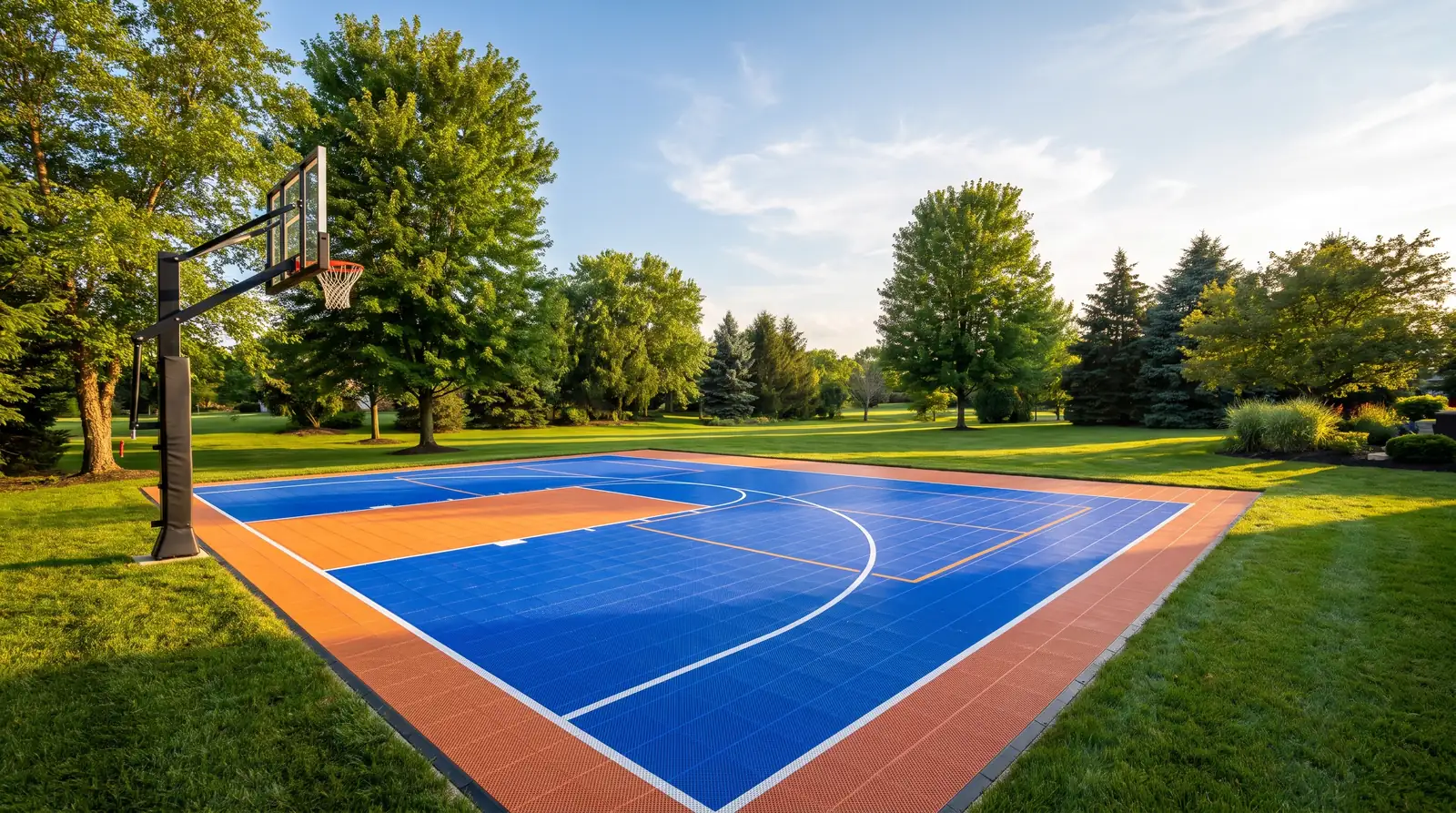
Basketball Court Dimensions: Full Court and Half Court
Basketball court dimensions depend on who the court is for. Every regulation court is 50 ft wide, and the length changes with the level of play: 84 ft for high school, 94 ft for college and the NBA. Below are the full and half court numbers in feet, the key, the three-point arcs and the hoop, plus the common backyard sizes that are not regulation at all, and why that is usually fine.
Regulation full court sizes: 50 x 84 high school, 50 x 94 NCAA and NBA
A regulation basketball court is a rectangle 50 ft wide. The width of basketball court surfaces is the one number every level of U.S. play agrees on; the length is what changes. High school courts, governed by the NFHS, run 84 ft. College (NCAA) and the NBA both play on 94 ft, the full size basketball court most people picture, and the size of every professional basketball court in the NBA. Internationally, FIBA specifies 28 m by 15 m, about 91 ft 10 in by 49 ft 3 in.
| Level | Full court (length x width) | Half court | Lane width | Three-point line |
|---|---|---|---|---|
| High school (NFHS) | 84 x 50 ft | 42 x 50 ft | 12 ft | 19 ft 9 in |
| College (NCAA) | 94 x 50 ft | 47 x 50 ft | 12 ft | 22 ft 1.75 in |
| NBA | 94 x 50 ft | 47 x 50 ft | 16 ft | 23 ft 9 in (22 ft in the corners) |
| FIBA | 28 x 15 m (about 91 ft 10 in x 49 ft 3 in) | 14 x 15 m (half of 28 m) | 16 ft | 6.75 m, 22 ft 1.75 in (6.6 m in the corners) |
Those are the standard basketball court size figures, and they describe the playing area inside the boundary lines. If you were looking for basketball court size in feet, the table is the answer. A full court basketball court adds a mid-court line and a 12 ft center circle between its two ends, and the outdoor basketball court dimensions are the same as indoor ones: nothing in the rule books changes because the court is outside.
A full basketball court is a big footprint: a full size outdoor basketball court at 50 by 94 ft covers 4,700 square feet, and a 50 by 84 ft high school court covers 4,200, which is why most full courts go to schools, community centers and large lots. If you do want one on tile, our basketball court kits include High School and College / Pro full court kits at those two sizes, plus a 42 by 74 ft Youth Full Court for smaller programs.
Regulation half court dimensions: 50 by 42 high school, 50 by 47 NCAA and NBA
Half court basketball dimensions are simply half the length at the same width. On a high school court that is 42 ft from the baseline to the half court line by 50 ft wide. On an NCAA or NBA court it is 47 by 50 ft. The Half Court preset in our Court Builder is sized to the 42 by 50 ft high school half court.
So the size of half court basketball has two regulation answers: 42 by 50 ft if you want high school half court dimensions, 47 by 50 ft for college or pro. Either way, the half court basketball court dimensions include one complete end of the court: the key, the free throw line and circle, and the three-point arc, which is everything a pickup game uses. If a half court is your plan, our half court basketball page covers tile, kits and layouts.
Common backyard half court sizes (not regulation): 20 x 25, 25 x 30, 28 x 50, 30 x 50
Most backyard courts are not regulation, and they do not need to be. The sizes homeowners actually choose between are sized to the yard and to how the court gets played, not to a rule book:
- 20 x 25 ft: A shooting area around one hoop.
- 25 x 30 ft: Room for 3-on-3.
- 28 x 50 ft: A common backyard half court size.
- 30 x 50 ft: The standard backyard half court, and the minimum viable footprint for a single sport.
- 40 x 60 ft: The most popular size overall: a recreational half court plus a full pickleball court on one surface.
Two limits from our Court Builder are worth knowing. Below 25 by 42 ft it stops drawing regulation basketball geometry, which is why the smallest sizes are called a shooting area and a 3-on-3 pad rather than a half court. And it draws a single half court on any court shorter than 70 ft; at 70 ft and longer you get two keys and a full court.
Whatever half court backyard basketball court size you pick, the right outdoor basketball court size is the one that fits your flat, usable ground with a 3 ft safety buffer around the tile perimeter. Trees, AC units, downspouts and fences do not count as court. Our guide to sport court sizes walks through measuring the yard, and a backyard basketball court from GTC can be sized to any of these footprints.
Basketball court layout and line diagram
A basketball court layout is built from a short list of lines: two sidelines and two baselines, a mid-court line and the center circle, and at each end a lane, a free throw line with its circle, and a three-point arc. These basketball court lines are the same whether they are painted on a gym floor or included with a tile court, and in our Court Builder you choose the line color so the basketball court markings stand out against your surface.
Reading the diagram. Each end holds the key, the free throw line and the arc. A half court is everything from one baseline to the mid-court line.
The dashed arcs show a trick for family courts: one surface can carry more than one three-point line. The Court Builder draws the extra high school, NCAA or NBA arcs dashed and labeled, so the primary arc stays dominant.
Testing a layout on your own yard? Sketch it on graph paper at one square per foot and you have a simple basketball court grid, or let our sport court design tool draw the lines at your real size.
Adding a second sport? Our guide to multi-sport line markings shows how a pickleball basketball court overlays both sets of basketball markings and pickleball lines on one surface in contrasting colors, and our multi-sport court page covers the tile.
Key, lane and free throw line
The key, also called the lane or the paint, is the rectangle under each basket. Basketball key dimensions differ by level: 16 ft wide in the NBA and FIBA, 12 ft wide in NCAA and high school play. The free throw line sits 15 ft from the face of the backboard, which puts it 19 ft from the baseline, so the key runs 19 ft deep.
Keep those basketball dimensions in mind when you plan a small court. On a shallow backyard pad, the key and the arc are the first lines to run out of room, so check the depth you have before you settle on a width.
Three-point arc distances: high school, NCAA, NBA
The three-point line is measured from the center of the basket, and it is the line that varies most:
- High school (NFHS): 19 ft 9 in.
- NCAA: 22 ft 1.75 in, for men since the 2019 to 2020 season and for women since 2021 to 2022.
- NBA: 23 ft 9 in at the top of the arc and 22 ft in the corners.
- FIBA: 6.75 m (22 ft 1.75 in), and 6.6 m in the corners.
The center of the rim sits 5.25 ft (5 ft 3 in) from the baseline in our Court Builder layouts, so add that to the arc to see how deep a pad must be: the top of a high school arc lands 25 ft from the baseline and the top of an NBA arc lands 29 ft out. That math is the quickest way to tell whether a full arc fits your yard or whether a shorter high school arc is the better choice.
Hoop placement and rim height
The official basketball hoop height is 10 ft from the playing surface to the top of the rim, at every level of organized play. That makes basketball goal height the easiest number on this page: high school, college and the NBA all use it. The backboard face sits 4 ft inside the baseline.
| Marking | Standard |
|---|---|
| Rim height | 10 ft from the playing surface to the top of the rim, at every level |
| Rim inside diameter | 18 in |
| Backboard (pro and college) | 6 ft wide by 3.5 ft tall (72 by 42 in) |
| Backboard face | 4 ft inside the baseline |
| Free throw line | 15 ft from the backboard face, 19 ft from the baseline |
| Lane (key) width | 16 ft in the NBA and FIBA, 12 ft in NCAA and high school |
| Center circle | 12 ft in diameter |
Those are the basketball hoop dimensions for regulation play. A standard basketball hoop size for home use is a separate choice, because a backyard backboard does not have to match the 72 in regulation board. The two hoops in our court accessories range use a 60 in tempered glass backboard (Pro Adjustable Basketball Hoop) and a 54 in acrylic backboard (Driveway Basketball Hoop), and both adjust from 7.5 to 10 ft, so younger players can start low and move up to regulation height.
Outdoors, check the space above the hoop as well as the ground: plan 15 ft or more of overhead clearance with clear sight lines.
Ceiling height for indoor courts
Indoors, the floor plan is only half the fit. We recommend a minimum 16 ft ceiling for basketball, compared with 12 ft for pickleball or tennis, since a 10 ft rim leaves a low ceiling little room for the arc of a shot. The slab should be flat within 1/8 in per 10 ft with a moisture barrier, and a temperature-controlled room keeps tile performing year-round.
Our indoor basketball court page covers the indoor tile lines.
Build a court to these dimensions
GTC supplies modular court tiles, court kits, lines and accessories. We do not pour concrete or asphalt or paint courts: the tile goes on top of a base, and base work is quoted by a local contractor. Send us your measurements and we will return a free CAD layout drawn to your real dimensions. If you would rather not install it yourself, a basketball court professional from our certified installer network works from that approved CAD layout.
- Basketball Court KitsFamily, half court and full court kits. Planning an outdoor full basketball court? Kits come in 50 by 84 ft and 50 by 94 ft.
- Half Court BasketballPlanning a backyard half court: sizes, tile and layouts.
- Backyard Basketball CourtsModular tile courts with regulation lines, custom logos and up to a 15-year limited warranty.
- Hoops and AccessoriesAdjustable hoops, containment fencing and the rest of the court package.