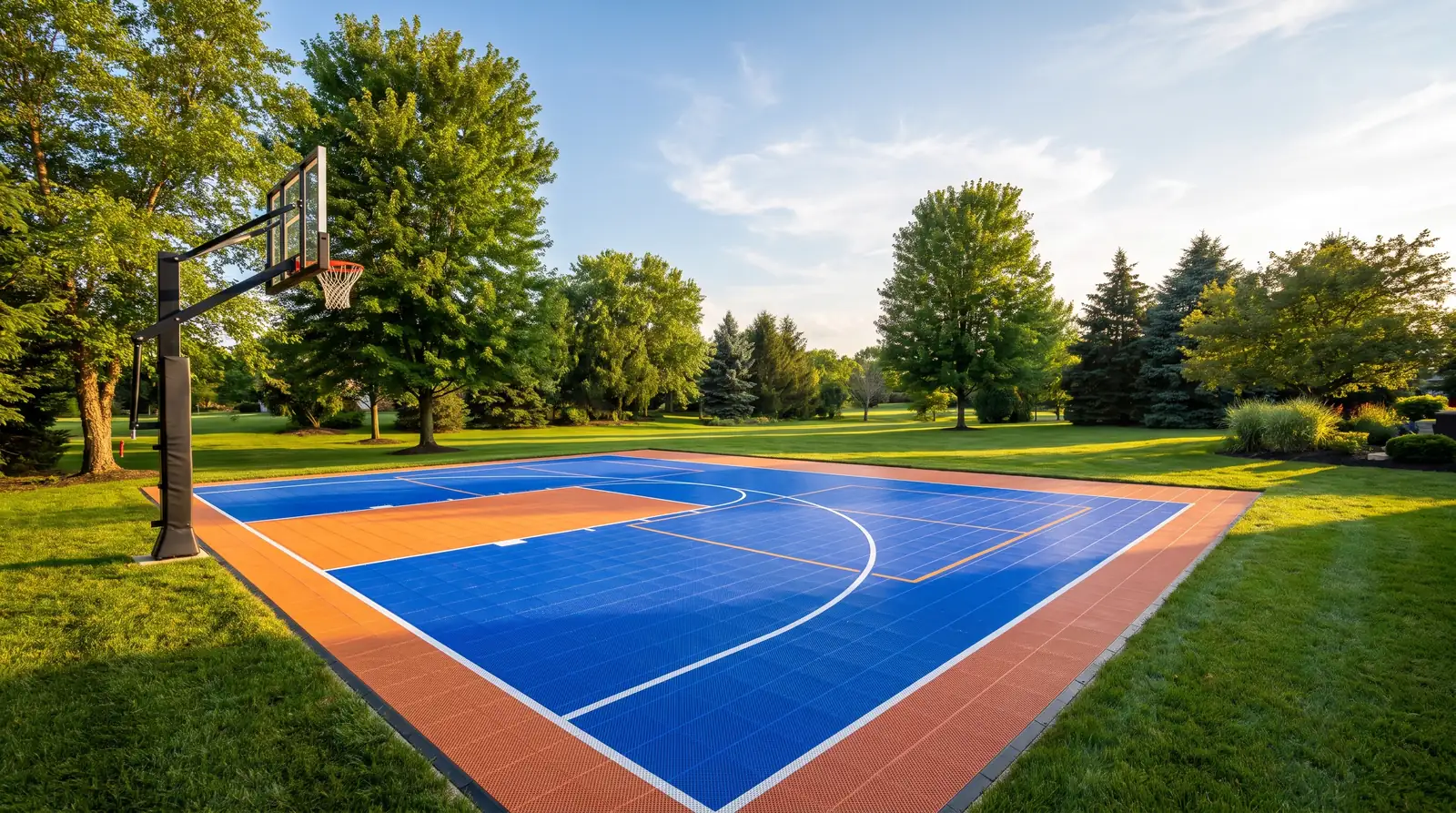
Sport Court Sizes: What Fits in Your Backyard?
Court sizing is the first question every homeowner asks, and the good news is that even modest backyards can fit a great court. Most backyard sport court sizes fall into three steps: a 30 × 50 ft minimum, a 40 × 60 ft sweet spot and a 40 × 78 ft ideal. Here's what each one fits and how to measure your yard.
Minimum Viable Size: 30 × 50 ft (1,500 sq ft)
- One regulation pickleball court (20 × 44 ft) with safety buffer
- A half-court basketball setup
- A small multi-sport surface
The Sweet Spot: 40 × 60 ft Multi-Sport Court Dimensions
This is the most popular choice, and the Court Builder's default. A 40 × 60 ft court fits:
- One full pickleball court with generous runoff
- A recreational basketball half-court
- Volleyball net setup (crossways)
- Badminton or bocce lines
A basketball court with two keys needs 70 ft of length before the Court Builder will draw one, so a full court starts at the next size up.
Of all the multi sport court dimensions we draw, this is the one that balances yard space and play best. Choosing a multipurpose court size comes down to which sports you want on the surface at once. See how the lines stack on a multi sport court.
The Ideal: 40 × 78 ft (3,120 sq ft)
At 40 × 78 ft you get regulation pickleball and a full recreational basketball court on the same surface, overlaid in contrasting line colors rather than sitting next to each other. These multi court dimensions are the choice for serious players and households with teens and adults.
Backyard Basketball Court Size Options
If basketball is the main sport, the backyard basketball court size you choose depends on how you play. The sport court dimensions backyard owners pick for basketball usually fall into these steps:
- 20 × 25 ft: a shooting area
- 25 × 30 ft: room for 3-on-3
- 30 × 50 ft: the standard backyard half court
- 40 × 60 ft: a half court plus a regulation pickleball court with a safety buffer
- 50 × 84 ft: a full court
Below 25 by 42 ft the Court Builder stops offering regulation basketball geometry, which is why the two smallest steps are a shooting area and a 3-on-3 setup rather than a true half court. For regulation keys, arcs and rim height, see our guide to half court basketball dimensions. Backyard basketball court dimensions also need height: a hoop wants 15 ft or more of overhead clearance.
How to Measure Your Yard and Plan the Safety Buffer
- Measure the flat usable area (don't include slopes or landscaping)
- Note any obstacles: trees, AC units, downspouts, fences
- Plan a 3-foot safety buffer around the tile perimeter
- Head to the Court Builder and enter your court dimensions
Your sport court dimensions are the tile, not the yard. Subtract the safety buffer from your flat usable area first, then pick the largest court that fits what is left.
Setbacks and Zoning
Your property lines shrink the usable space too. Setbacks commonly run 5 to 10 ft from property lines, but the only authority for your address is your local building or zoning department, and your HOA may have its own rules. A backyard court is commonly treated as an accessory structure, so check impervious coverage limits as well. Our guide to permits and setbacks covers what to ask before you order.
Frequently Asked Questions
Q: What is a good size for a backyard basketball court?
A: A 30 × 50 ft half court is the standard, and it is a good size for backyard basketball court play for most families. With less room, a 20 × 25 ft shooting area or a 25 × 30 ft 3-on-3 pad still works. A home basketball court size of 40 × 60 ft adds a regulation pickleball court alongside the half court.
Q: What size multi-sport court fits in a backyard?
A: Most backyard multi-sport courts fall between 30 × 50 ft and 40 × 78 ft. 40 × 60 ft is the most popular, fitting pickleball with generous runoff, a recreational half court and a crossways volleyball net. 40 × 78 ft adds a full recreational basketball court.
Q: How much space do I need around a sport court?
A: Plan a 3-foot safety buffer around the tile perimeter, measured on flat usable ground, and keep clear of trees, AC units, downspouts and fences. Setbacks from property lines are set by your town, so confirm them with your local zoning office.
Q: What are typical home basketball court dimensions?
A: Common home basketball court dimensions are 20 × 25 ft for shooting, 25 × 30 ft for 3-on-3, 30 × 50 ft for a half court and 50 × 84 ft for a full court. A court with two keys needs at least 70 ft of length in the Court Builder.
Q: Can I build a court on a sloped yard?
A: A slope under 1% is manageable with the right gravel base prep. Steeper grades need grading first. Request a free site assessment.
Q: Can I expand my court later?
A: Yes. Modular tile is the best surface for phased installs - just add more tiles and edge pieces as your budget allows.
Q: Does a sport court need a permit?
A: Assume yes until your municipality tells you otherwise. A backyard court is commonly classified as an accessory structure, which usually means a zoning review for setbacks and impervious coverage, and a new concrete or asphalt base almost always needs a permit of its own. Some towns treat a tile surface laid on an existing pad as no work at all. Check with your local zoning office before you plan around either answer.